
What Is the Relational Friction Tax?
It’s an uncalculated leak in your bottom line

High-growth organizations often struggle because of the invisible operational cost of brilliant people and systems not getting along.
A Problem You Can’t Solve from the Inside
Chronic friction in an organization remains unsolved precisely because the leaders and employees are part of the system they are trying to change.
When you are the “hub” of the wheel, it is a structural impossibility to objectively rewire the spokes. This is the “itch” that internal initiatives rarely scratch.
We provide the external systemic architecture to identify and resolve the hidden patterns that are often invisible to those operating within them.
We move beyond facilitating meetings to working alongside you to repair the structural and relational havits that limit your execution and impact.
Three common challenges:

The Symptom: Your team members are experts, but they’re only willing or able to solve problems vertically. Every cross-functional decision eventually lands on your desk for "integration." Cross-department collaboration breaks down because no one steps up to make the call across functions.
The Tax:Leader Exhaustion & Stalled Growth. You become the single point of failure. While you are busy refereeing "business as usual," nobody is architecting the future. The bottleneck is often a wiring problem, and it scales worse, not better, the bigger your organization gets.
How Systemic Team Coaching Resolves This: We strive for more than better communication. We rebuild the actual decision pathway so cross-functional calls stop routing through you by default.
Through our Tier 1 — Foundational program, we identify exactly where decisions are getting trapped at the hub, then coach the team to build the lateral trust and shared authority needed to resolve those decisions at the spoke level, where the expertise already lives.
Hub & Spoke Bottlenecks

Artificial Harmony
The Symptom: Meetings are polite, agreeable, and efficient. Then, the unspoken disagreement and side chats begin because the real conflict was never aired in the moment. What looks like alignment is often just an absence of psychological safety: nobody believes it's safe to say what they actually think while it would still matter.
The Tax:The Execution Gap. You lose weeks to passive-aggressive delays and "re-work" on decisions that everyone supposedly agreed to. Worse, the team normalizes the gap between what's said in the room and what's believed outside it, and that erosion adds another layer every time it happens unchecked.
How Systemic Team Coaching Resolves This: Psychological safety is built by practicing real disagreement, with a coach in the room holding the team accountable to surface what's actually being avoided. We work inside your real meetings, not simulated ones, so the team builds the muscle of productive conflict on the decisions that actually matter.

Silos & Egos
The Symptom: Functional leads optimize for their own vertical KPIs, hoarding headcount and budget like a zero-sum game, even when it impedes the collective mission. Departmental silos form because most incentives in the system reward defending your function over serving the whole.
The Tax:Wasted Opportunity Cost. You’re invested in the brightest talent and leadership that are effectively canceling each other out, prioritizing departmental wins over total stakeholder value. This is the most expensive pattern on the Friction Tax, because it never shows up on any individual scorecard.
How Systemic Team Coaching Resolves This: This is rarely a Tier 1 fix — silo behavior usually means a team has mastered its internal wiring but hasn't resolved friction with peer departments. Our Tier 2 — Advanced program targets exactly this "Seam Friction," moving the team from defending its own vertical to creating shared, Outside-In value for the wider organization and its stakeholders.
Relational friction exists on a spectrum. Whether it manifests as an invisible tax on decision velocity or an overt departmental standoff, it represents potential energy that remains untapped.
In this moment of rapid AI disruption, process and role realignment, unresolved relational friction gets AMPLIFIED.
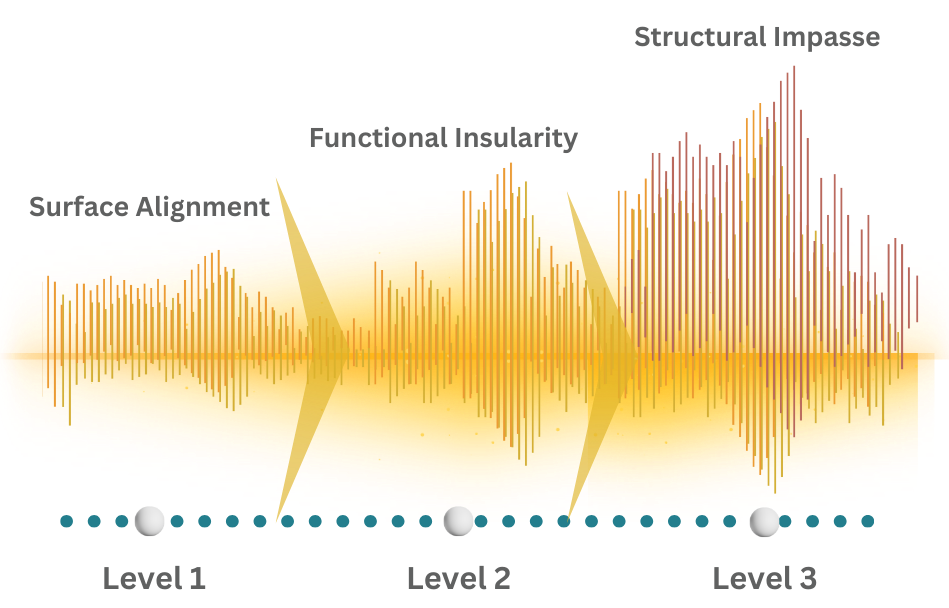
The Relational Friction Scale™
Level 1: Surface Alignment: From the outside, this team is cordial, but beneath the surface, the "wiring" is loose. Action is tentative, and high-stakes truths are avoided to maintain harmony.
Level 2: Functional Insularity: Leaders prioritize their specific verticals. Cooperation becomes transactional between silos, requiring constant mediation to align competing objectives.
Level 3: Structural Impasse: Hub-and-spoke dependencies frequently overwhelm the leadership system. Managing the internal friction between leaders has become normalized and is built into processes and culture.
How’s the health of your team?
Take the free Team Doctor Health Assessment to get a personalized report showing:
Where your team’s relational capabilities are strongest
Where your team's friction is highest
Tips and exercises to try with your team today
Whether a diagnostic conversation is the right next step