Your Team's AI Adoption Gap Is Concealing a Trust Problem.
Your team's AI skills gap is eroding its trust. A relating problem, dressed up in a skills gap costume.
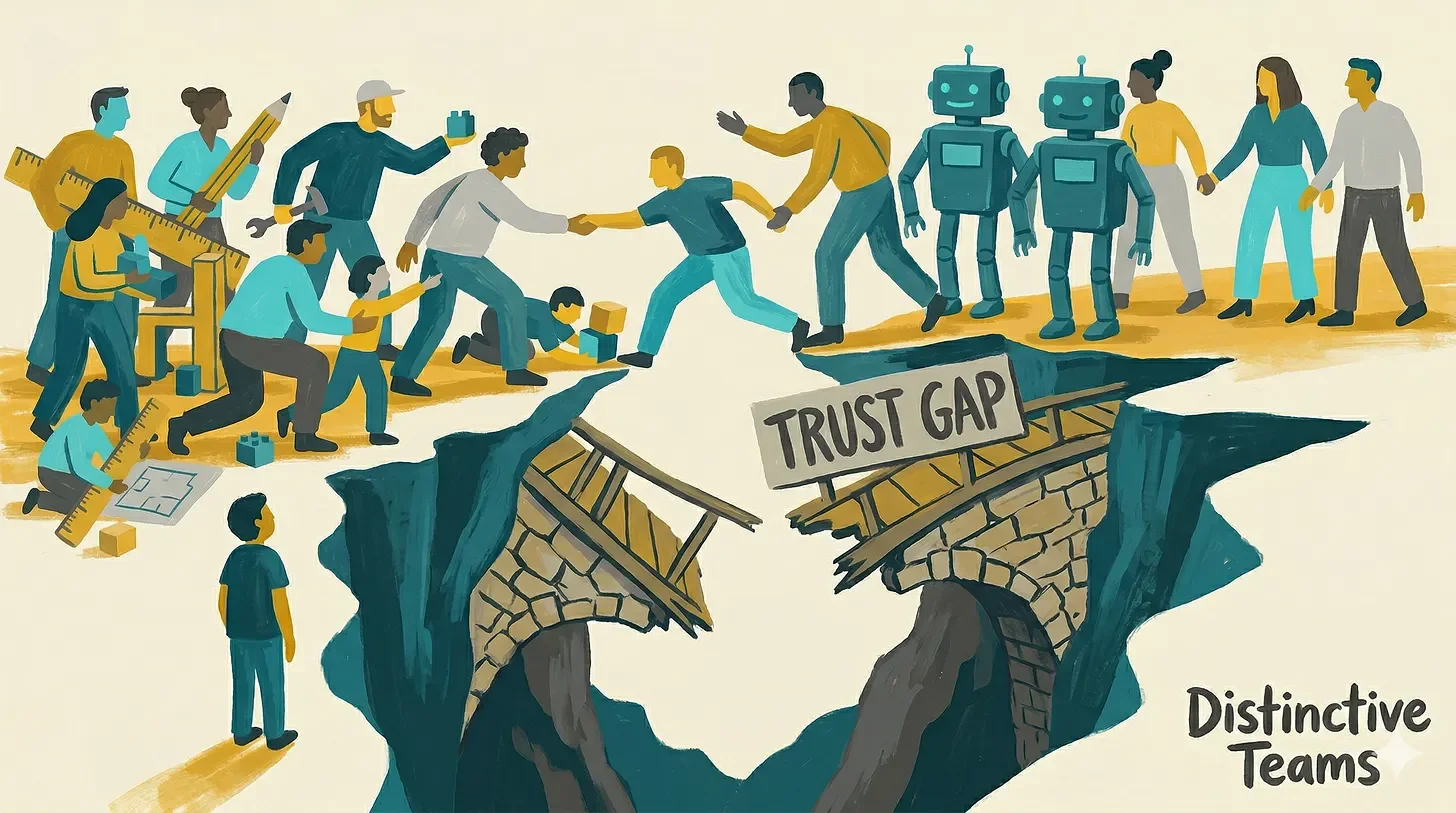
Every leadership team right now is living with this dynamic, even if no one has labeled it.
A handful of people on a team have moved fast with AI. They are generating in minutes what used to take hours. The rest of the team is somewhere behind: watching, waiting, calculating whether falling further behind is safer than admitting they don’t know where to start.
Most organizations are treating this as a skills problem. At Distinctive Teams, we see it differently: this is a trust problem, running at a speed most organizations have never had to manage before — and it's exactly the kind of team friction that systemic team coaching is built to surface and resolve.
When IBM moved our facilitators team from legacy training tools to Zoom, something happened that I did not fully understand until some time later.
The new platform not only changed how we delivered training, it created a new professional identity: the “Zoom facilitator” who could read a virtual room, use different backdrops to bring energy across a grid of faces on a screen, use the chat, the polls, and the breakouts in ways that felt engaging and alive. Some of us found that identity quickly. Others did not.
The dynamic I watched happen on our team was revealed to be more of a trust problem than a lack of skill. The gap between those who had found the new platform and those still finding their footing had changed the texture of how we worked together. Only later was I able to connect the dots: who asked whom for help. Who pulled back in team meetings. Who started, slowly, to disconnect.
I have been watching the same story play out in every team I work with now. Except the tool is AI. And the pace is unlike anything we’ve have seen before.
What the Research Confirms
The business case for addressing this is compelling.
Paul Zak's neuroscience research, published in the Harvard Business Review, found that people in high-trust teams report 50% higher productivity, 76% more engagement, and 106% more energy at work. High-trust organizations make decisions 32% faster and show 21% higher profitability.
Meanwhile, AI early adopters are already 14% more productive than colleagues not using the tools, a gap that widens every week. And according to DataCamp research, AI-related skills shortages alone put up to $5.5 trillion of economic value at risk globally by 2026.
The teams that close this gap fastest are the ones with the trust architecture to learn together.
The difference between a team that ripples and a team that spins
Many organizations are now designating internal AI champions, the “super users” or so-called black belts who can model adoption for the rest. It’s a reasonable structural response. But it only works if the relational fabric of the team is already strong enough to carry the knowledge transfer. If I trust the person ahead of me, their proficiency is a pull. I lean in. I ask questions. I watch how they work. If I do not trust them, their proficiency becomes a wall. I do not adopt AI. I develop a quiet resistance to the person carrying it, and I call it a values concern, or a workload issue, or just not my thing.
Executive coach Keith Ferrazzi described the black belt approach in Axios last month: “the people who are out ahead of others become the best spokespeople.” True. But incomplete. The spokesperson only works if people want to listen. And people only want to listen to someone they trust. You cannot separate an adoption strategy from the relational health of the team executing it.
This is the gap inside the gap. And it is the one most of organizations are not managing.
“The gap between your AI early adopters and everyone else is a training problem and a trust problem. Your team is learning at a different pace, and their relationship problems will not be fixed with a course.”
What does closing this gap actually require?
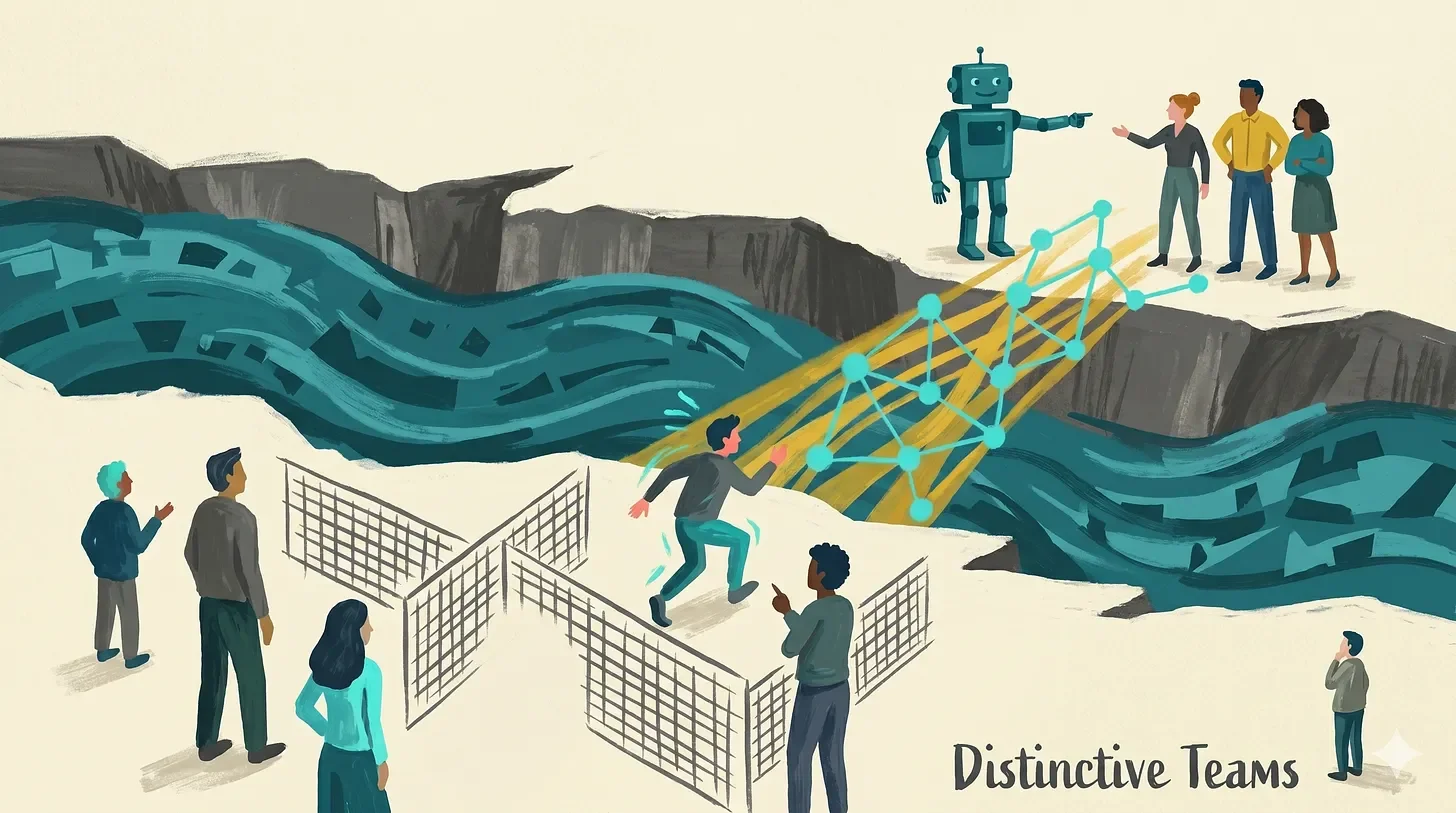
The difference between teams that navigate this well and teams that do not is the team’s capacity to hold difference without fracturing; to treat the skill gap as something that needs attention from the collective, not as an identity problem belonging to the individuals falling behind.
At Distinctive Teams, we describe what happens to teams navigating this well as a ripple rather than a spin.
Rippling teams generate coherent energy outward: shared learning, transparent experimentation, a collective intelligence that grows because people feel safe enough to say "I tried this and got completely lost" without it costing them status.
Spinning teams burn that energy internally on unresolved friction, on the unspoken resentments and the widening gap nobody is naming. This is the Relational Friction Tax multiplying in real time, and it's precisely the dynamic our Friction Scale is designed to diagnose.
The difference is the team's capacity to hold differences without fracturing.
In our work, the first move is almost always the same: create a container for transparency. A structured team practice where everyone, early adopters and skeptics alike, report back on what worked, what failed, and what they learned. Successes and dead ends, both. This is the early work of rewiring a team's operating norms — diagnosing the system before prescribing a fix.
What this does is redistribute the social cost of not knowing. When the most skilled person on the team can say "I hit a wall with this for two hours," the person who has been silently struggling stops feeling like they are falling behind. They feel like they are in it together.
That is how an AI champion actually works: by demonstrating the discipline behind the mastery, not just the mastery itself.
Leader Reflection
Who on your team is quietly struggling with AI, and have you created a space where they can say so without losing credibility?
If you are not sure, that uncertainty is itself useful information. It means the container does not exist yet.
Curious where your team's friction is actually coming from? Our Team Doctor Assessment gives you a fast, structural diagnosis — the same kind of systemic team coaching lens we used here — so you can see what's driving the gap before it widens further.